Betfair Exchange Horse Racing: Back and Lay Guide
 Available in US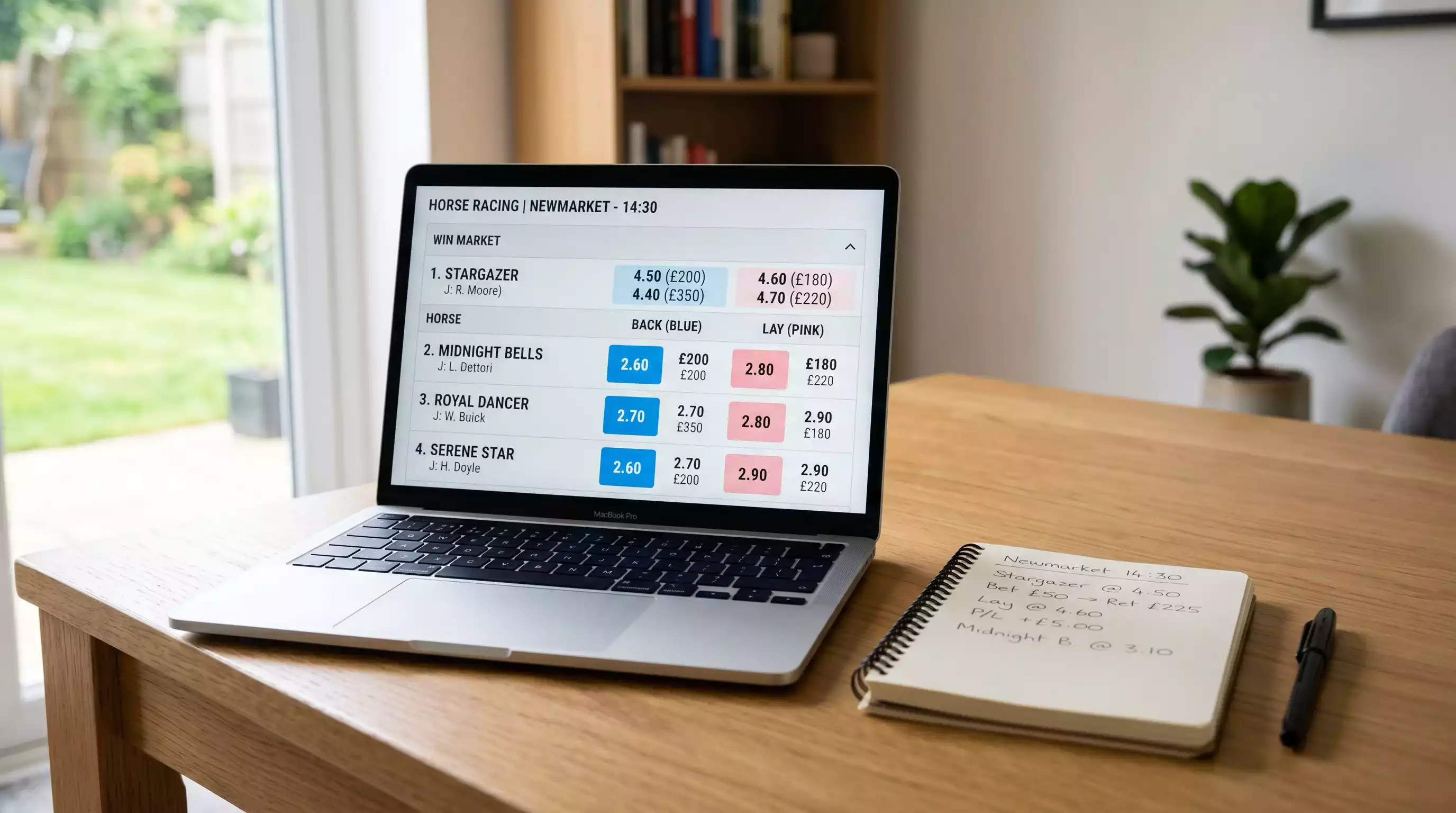
The first time I looked at a betting exchange, the numbers made no sense. Two columns of odds, blue and pink boxes, figures that didn’t match what bookmakers were showing. I closed the browser and went back to traditional betting for another six months. That was a mistake — exchanges opened up possibilities I hadn’t known existed.
Traditional bookmakers set prices and take your bets. Exchanges let punters bet against each other, with the platform just taking a commission. This peer-to-peer model enables things bookmakers can’t offer: laying horses to lose, trading positions like stocks, and often better odds because there’s no built-in bookmaker margin.
The UK betting market generates £3.7 billion annually, and exchange betting captures a meaningful slice. Understanding how exchanges work gives you tools that complement traditional betting — different situations suit different approaches. This guide covers the essentials for horse racing on Betfair Exchange, the dominant platform in the UK.
How Betting Exchanges Work
Forget everything you know about bookmakers for a moment. An exchange doesn’t set odds or take positions against you. It simply matches punters who want opposite outcomes.
When you back a horse on an exchange, another user is laying that horse — betting it won’t win. Your winning bet is their losing bet, and vice versa. The exchange connects you, holds the stakes, and takes a commission (typically 2-5%) from the winner. No bookmaker margin eating into your odds.
This creates a genuine market where prices reflect supply and demand. If lots of people want to back a horse and few want to lay it, the back odds shorten. If nobody wants to touch a horse as a backer but layers are confident it’ll lose, lay odds become increasingly attractive. Prices fluctuate constantly based on actual money rather than bookmaker opinion.
The commission model means exchanges make money regardless of results. They don’t care whether favourites win or longshots land — their cut comes from volume. This alignment of interests differs fundamentally from bookmakers who profit when you lose and have every incentive to limit or close successful accounts.
Backing vs Laying: Understanding Both Sides
Nevin Truesdale, when he was Chief Executive at the Jockey Club, once noted that regulators seemed to want to reduce gambling to “just small-stakes gamblers.” Exchanges offer an alternative perspective — they’re where serious money moves because the structure suits sophisticated betting.
Backing works identically to traditional betting. You think a horse will win, you back it at available odds. If it wins, you collect your stake multiplied by those odds minus commission. Simple.
Laying is the mirror image. You’re betting that a horse won’t win. If the horse loses (finishes second, third, or anywhere behind the winner), you collect the backer’s stake. If the horse wins, you pay out at the agreed odds. Your risk is called “liability” — the amount you stand to lose if the horse wins.
Understanding liability is crucial. When you lay a horse at 5.0 (equivalent to 4/1) for a £10 stake, you’re risking £40 to win £10. The backer’s potential profit becomes your potential loss. This asymmetry is why laying requires different thinking than backing — you need to be more certain a horse will lose than you would be about a horse winning at the same odds.
Both sides exist on every exchange market. You can back at the blue prices (what backers are willing to pay) or lay at the pink prices (what layers are offering). The gap between them — the spread — represents the market’s efficiency. Tight spreads mean liquid, competitive markets; wide spreads suggest thin trading.
Using Betfair for UK Racing
UK racing markets on Betfair are among the most liquid in the world. Major meetings like Cheltenham and Royal Ascot see millions matched per race. Even midweek cards attract enough money for practical betting, though spreads widen on minor races.
Liquidity matters because you need someone on the other side of your bet. A fantastic lay opportunity at 2.5 means nothing if only £20 is available at that price. Check the amounts shown beneath each price — that’s how much you can bet at those odds. For significant stakes on less popular races, you might need to wait for your price to be matched or accept worse odds that have deeper liquidity.
Timing affects what’s available. Markets firm up approaching race time as more money enters. Early morning prices might show wide spreads and thin liquidity; by ten minutes before the off, major races have tight markets and substantial sums available. I typically form views early but execute closer to race time when liquidity supports my stake size.
The in-play market transforms racing. Once a race starts, you can bet until the horses cross the line. Prices swing wildly based on position, pace, and perceived danger. A horse leading into the final furlong might trade at 1.5; get passed in the final strides and it crashes to whatever the actual result pays. This volatility creates trading opportunities but also significant risks.
Basic Exchange Strategies for Racing
Average turnover per race has fallen 15% compared to recent years, with affordability checks and market changes affecting how punters engage. Exchanges offer ways to adapt — strategies that don’t depend on finding winners every time.
Trading means backing and laying the same horse at different prices to guarantee profit regardless of result. Back at 6.0, then lay at 5.0 after the price shortens, and you’ve locked in profit either way. The skill lies in reading price movements and timing entries and exits. This requires discipline, quick execution, and acceptance that not every trade works.
Laying the field involves placing lay bets on multiple horses in a race, betting against several while hoping one with short odds wins. If the 2.0 favourite wins, you collect from all your successful lays on the other runners. If a longer-priced runner wins, your losses on that lay might exceed your gains. Risk management determines success.
Dutching spreads your stake across multiple selections to guarantee the same profit regardless of which one wins. Exchanges suit this because you can calculate precise stakes to equalise returns, and tighter odds than bookmakers mean less erosion of value.
Is Exchange Betting Right for You?
Exchanges suit some punters brilliantly and others not at all. The question isn’t which is better — it’s which fits your approach.
If you value best odds and hate having accounts restricted, exchanges deserve serious consideration. No bookmaker will limit you for winning on an exchange; they make money from commission regardless. If you want to bet against horses rather than always backing, laying is only available on exchanges. If you enjoy active engagement with racing — watching markets, trading positions, responding to in-play developments — exchanges provide tools bookmakers can’t match.
If you prefer simplicity, fixed prices, and quick bets without thinking about liability calculations, traditional bookmakers remain easier. The learning curve on exchanges is real. Mistakes cost money while you figure out what you’re doing.
Most punters I know use both. Bookmakers for Best Odds Guaranteed and convenience on straightforward back bets; exchanges for laying, trading, and markets where exchange odds clearly beat fixed prices. That combination extracts the best from each model while avoiding their respective limitations. The key is understanding what exchanges offer, then deploying that knowledge when circumstances fit.
Exchange Betting Questions
How do I use the Betfair Exchange for horse racing?
Create an account, deposit funds, and navigate to horse racing markets. Blue prices are for backing (betting on a horse to win); pink prices are for laying (betting against). Click your chosen odds, enter your stake, and confirm. Commission is deducted from net winnings.
What commission does Betfair charge?
Standard commission is 5% on net winnings, though this reduces with volume through the discount programme. Some markets and promotions offer reduced commission. You only pay commission when you win – losing bets incur no charge.
Can beginners use betting exchanges?
Yes, though there is a learning curve. Start with simple back bets, which work identically to traditional bookmakers. Progress to laying and trading once you understand liability and market mechanics. Many beginners find exchanges intimidating but worth the initial effort.
Prepared by the bet for Horse Racing editorial staff.